
How to purge your hot tub plumbing lines before winter
Water care · September 25, 2026 · 5 min read
Your hot tub can look perfectly clear and still be dirty where it counts. The problem usually isn't in the water, it's in the pipes behind it.
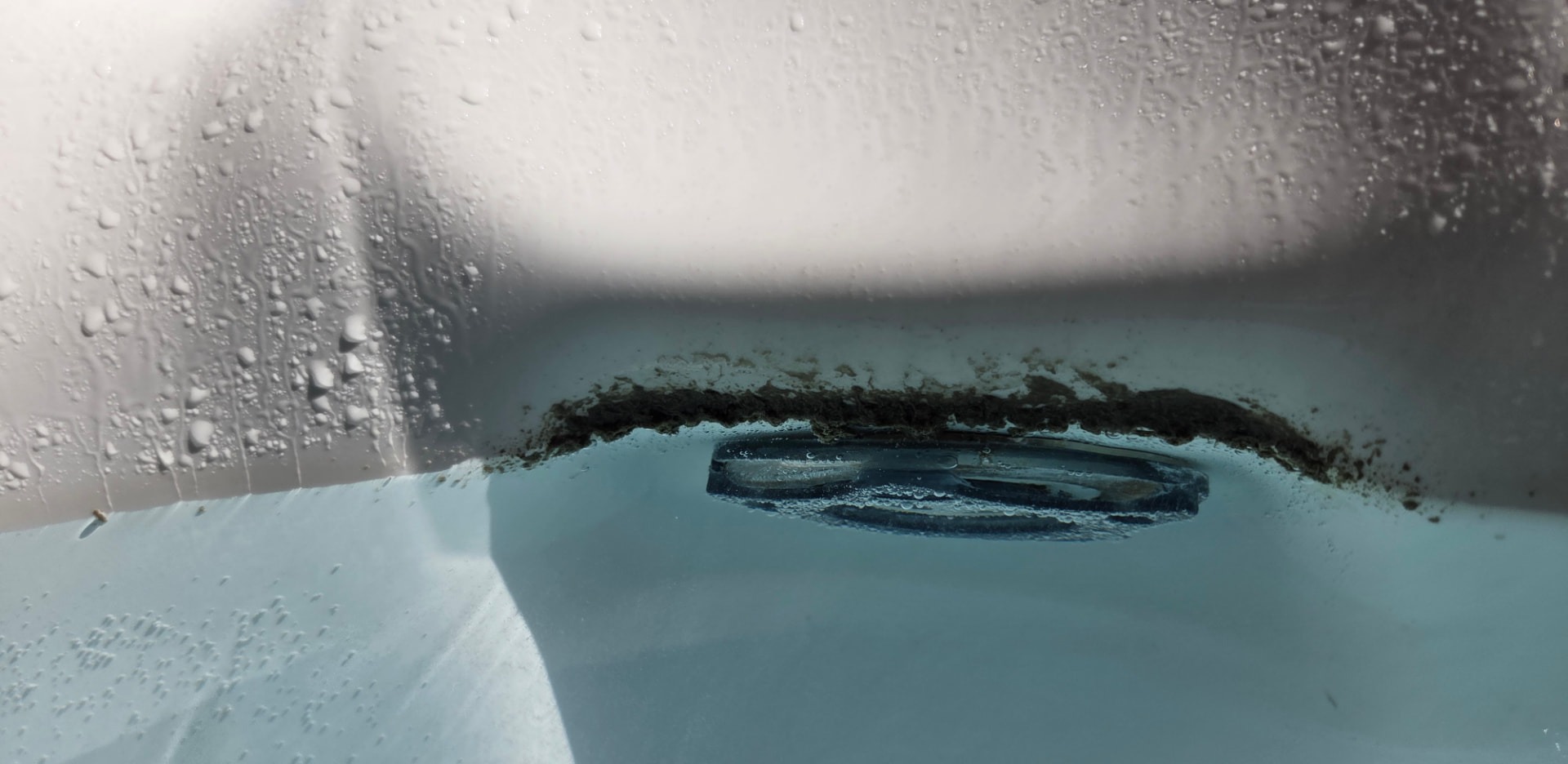
I went to meet an owner at Big White recently whose tub we'll be looking after this winter. The water was cloudy and there was a scum line building along the shell at the waterline. As soon as I see that, I know there's probably biofilm building up in the plumbing and it's time for a good line purge. After talking to a few other owners on the mountain, it turned out to be something a lot of people run into when they look after their own tub.
So I filmed a full purge on our own tub, start to finish, to show exactly how it's done.
What is biofilm in a hot tub?
Biofilm is a slimy layer of bacteria that attaches to the wet surfaces inside your tub and protects itself with a sticky coating. It feeds on everything people bring into the water: body oils, lotion, sunscreen, cosmetics and skin cells.
Some of it you can see. That slippery band along the waterline and the film under the cover usually have biofilm in them. But most of it is out of sight, lining the inside of your plumbing, your jets and your air lines, where no brush or wipe-down ever reaches.
Why biofilm is a problem
The protective coating shields the bacteria underneath from your sanitizer, so chlorine or bromine in the water can't fully reach them. The colony also sheds free-floating bacteria back into the water continuously, which is how it spreads to new surfaces and why your sanitizer demand keeps climbing.
That's why a tub can test perfectly and still go cloudy three days after a refill, or burn through chemicals faster than it should.
It matters for health too. The bacteria behind hot tub rash and the bacteria behind Legionnaires' disease can both live inside biofilm, where disinfectants have a much harder time reaching them. Hot tubs are a good environment for it by design: warm water, jets that aerate and deplete sanitizer, and a small volume of water shared by several people.
Signs your hot tub has biofilm
- Sanitizer levels dropping faster than they should, even after a fresh fill
- Water going cloudy within days of a water change
- Foam building up when the jets run
- A musty or stale smell
- A slippery feel along the waterline
- Flakes or dark specks coming out of the jets
If your tub does any of these despite regular chemical care, the lines are the likely cause.
Why draining doesn't fix it
This is the part most owners don't realise. Draining removes the water, not the biofilm. The colony stays attached inside the plumbing, and the moment you refill, it starts seeding your fresh water all over again.
It has to be broken down and flushed out of the lines before you drain, while there's still water in the tub to carry it out. That's what a purge does.
How to purge your hot tub lines
You do this on the water you're about to dump, not on a fresh fill.
- Start with the tub warm. Around 100°F is ideal. A purge on cold water works far more slowly and is the most common reason people get a disappointing result.
- Dose the old water. Add your purge cleaner, measured to your tub's actual water volume. We use Ahh-Some, which you can order online or find at some spa shops. Follow the label, because the concentration varies between their formulas and guessing usually means underdosing.
- Remove the filters and drop them in. They get deep cleaned in the same cycle, and you don't want the filter catching what you're trying to flush out.
- Open everything up. All jets on high, blower on, and open the air control valves. Those air lines hold a lot of biofilm and they only get cleaned if the valves are open.
- Run it for at least 30 minutes. Foam will appear quickly. That's normal, and it's residue coming out of the plumbing. Make sure you wipes and clean the waterline as biofilm build up during the treatment as it is way easier to remove wet than dry.
- Drain, wipe and rinse. Drain the tub, wipe the shell and the waterline, and rinse the filters properly with a hose.
- Refill and rebalance. Fresh water, balanced from scratch, back up to temperature.
A note on expectations: the tub in our video isn't very old, so it didn't give up a huge amount. If yours is a few years old, or it's been sitting since spring with water in the lines, you'll see considerably more than we did.
How often should you purge?
The general guidance is every three to six months, timed with a water change. At Big White that works out naturally around the season: once coming out of the summer shutdown, and again partway through winter if the tub is getting heavy rental use. With our full-season hot tub care, it's built into the schedule.
What if the tub was winterized and drained?
You can't purge an empty tub, since the product needs water to circulate. If your tub was drained for the summer, fill it at startup, run the season normally, and do the purge with your first water change instead. The water that sat in the lines through summer is exactly why it's worth doing.
Do we do this for our clients?
Yes. Every tub we look after gets a full line purge at some point in the season, either at startup where the tub still holds water, or with the first water change. It's included in both our packages, because a tub with clean plumbing is far easier to keep clear all season than one that's fighting biofilm from December on.
If you'd rather handle it yourself, everything above is what we do, and there's nothing in it you can't manage with a bottle of purge cleaner and an afternoon.
Booking winter 2026-27
Full-season hot tub care for chalets and rentals at Big White.