How to start up your hot tub for winter at Big White
Startup and shutdown · September 29, 2026 · 7 min read
At Big White, the hot tub off-season is summer. Tubs sit empty or idle from April to November, then get filled and fired up right as the nights drop below freezing. Starting a tub in freezing weather is a different job from starting one in May, and it's why most of the problems we see all winter trace back to how the tub was started.
Here is the order we work in, and the things worth checking before you put a single litre in.
When should you start up your hot tub at Big White?
Earlier than you think. From a cold November fill, a typical tub takes 4 to 12 hours to reach 100°F, and longer when it's -15 outside. So you should fill it at least two days before you want to use it, not the morning of.
If you're driving up from Kelowna, Vancouver or Calgary for the first weekend, that's the catch. You can't fill it Friday evening and get in Friday evening. You either have to come up midweek, or have someone start it before you arrive.
If your place is a rental, your first booking is probably opening weekend. That's the worst possible moment to find out the heater is dead. That's why we recommend starting up your tub a week or more before your first guest arrives. This gives you time to address any issues that come up. If the tub has been sitting unused for a couple of months, there's also a good chance that O-rings or gaskets on the pump or heater may need to be replaced.
Before you fill: what to check
Do this while the tub is empty and dry.
- Open the equipment bay and look for cracked fittings, white mineral crust, or dark stains under the pumps. Any of those point to a slow leak that was weeping before shutdown. The union O-rings are the usual suspect, see below.
- Look around the pump shaft seal for drips or rust streaks.
- Confirm the drain valve is fully closed and capped.
- Inspect the cover. Waterlogged foam, torn vinyl, a split hinge seam. A saturated cover is the biggest heat loss a tub can have, and it gets worse fast in a mountain winter.
- Check the shell for cracks and the jets for anything loose or missing.
- Look at your filters. If they’re more than a season old, replace them rather than trying to stretch them through one more winter. We recommend starting up your tub with fresh filters at the beginning of the season.
Filling the tub
If the tub has sat empty for a few months, the shell will have collected dust, pollen and whatever blew in under the cover. Don't fill over it. Wipe the shell down with a spa-safe cleaning solution, like diluted white vinegar, rinse it well with the hose, and pull the rinse water out with a shop vac. Skip household cleaners. Most of them foam the moment the jets run, and some leave a residue that throws your first chemistry readings off.
Fill through the filter housing, not over the side. Running the hose into the filter well pushes water back through the plumbing and forces air out ahead of it, which is the simplest way to avoid an airlock. An airlock means the pump runs but nothing circulates, and the heater won't fire.
Fill to the manufacturer's line, usually just above the highest jets. Too low and the pump pulls air. Too high and you lose water over the edge the first time someone gets in.
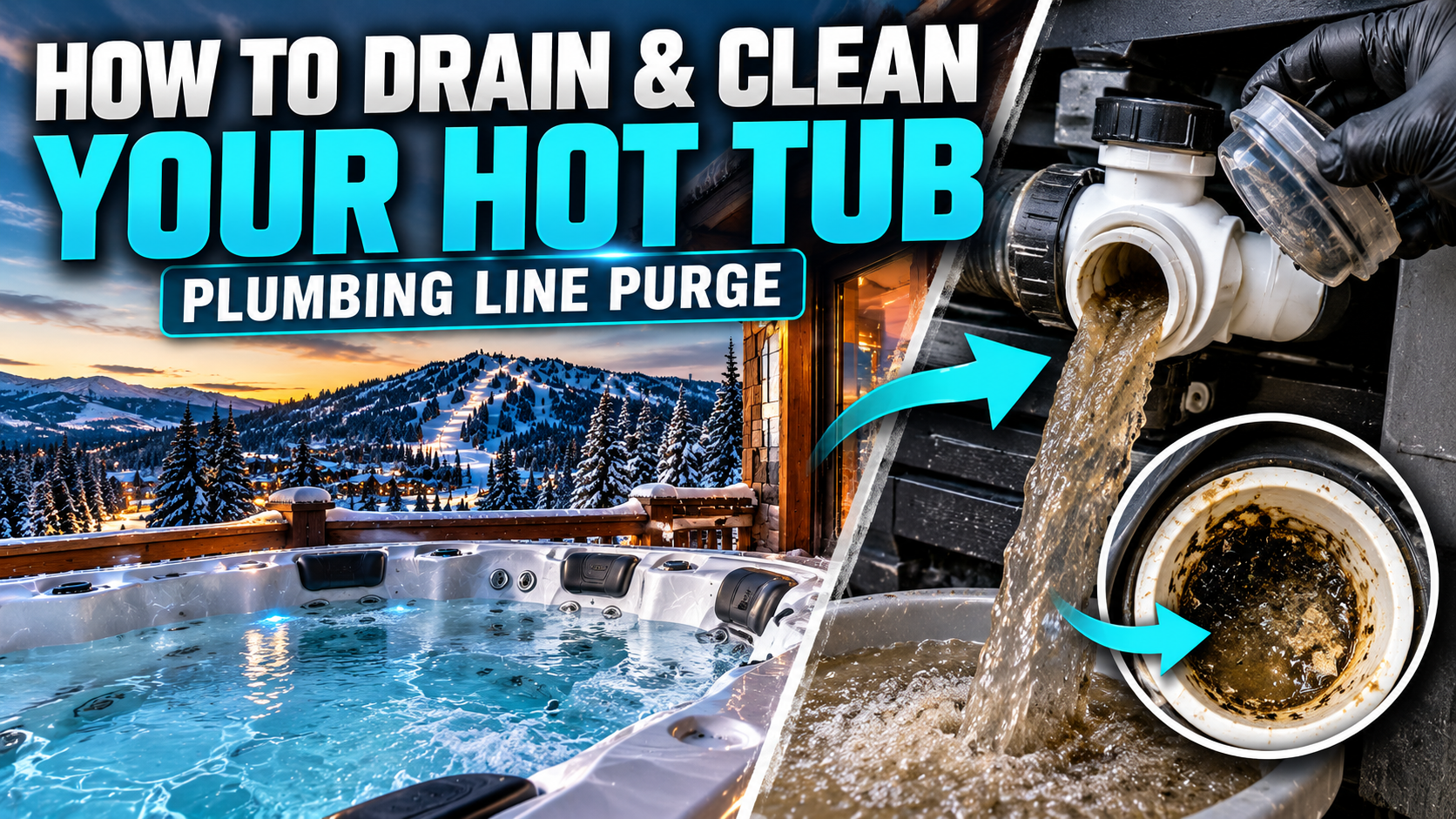
If your tub was shut down with water still sitting in the lines, run a purge before you drain and refill. There's a full guide to that here. Water that sat in the plumbing since April is the main reason a fresh fill goes cloudy in its first week.
Getting it running
Power on, and stay with it for the first stretch rather than walking away.
- Listen to the pump. A steady hum is right. Gurgling, surging or rattling usually means air trapped in the system. Many tubs have a bleed valve on the pump to release it.
- Check that water is actually moving. Look for flow at the jets, not just noise from the equipment bay.
- Confirm the heater has engaged. Most control packs show a heating indicator. If the temperature hasn't moved after an hour, stop and investigate rather than leaving it overnight.
- Walk the equipment bay again after 15 minutes running and look for drips. Fittings that were fine dry sometimes weep under pressure.
- Put the cover on and leave it on. The tub heats far faster covered, and in November the difference is hours.
Leaks at the pump union or heater after a dry summer
This one catches people every year. The tub was fine in April, sat empty all summer, and now there's a drip in the equipment bay the moment it's refilled.
The cause is almost always a rubber O-ring or gasket. The big threaded nuts that connect your pump and heater to the plumbing are called unions, and each one seals on an O-ring inside it. When those sit dry for six months the rubber dries out, hardens and shrinks a little. It sealed fine under constant water. Dry, it doesn't spring back the same way, and the first time pressure comes on it weeps.
You'll usually see it as a drip or a wet ring at the union nut, sometimes only when the pump is running, and sometimes as water pooled at the bottom of the equipment bay by morning.
What to do, in order:
- Turn the power off at the breaker before you put your hands anywhere near the equipment.
- Hand-tighten the union nut. Snug, then about a quarter turn more. That fixes it more often than not. Don't reach for a wrench. The unions are plastic and they crack when overtightened, which turns a five-minute fix into a parts order.
- If it still drips, undo the union and look at the O-ring. If it's flattened, cracked, hard, or has a visible flat spot where it sat, it's done. They cost a few dollars and any spa shop carries them. Take the old one with you to match the size.
- Before you reassemble, put a thin coat of silicone-based lubricant on the O-ring. Silicone only. Petroleum-based products like Vaseline break rubber down and make the problem worse next year.
- Seat it, hand-tighten, power on, and check again after fifteen minutes under pressure.
The heater unions work the same way. If the leak is coming from the heater housing itself rather than the union nut, that's a different job, usually a gasket inside the heater assembly, and worth having someone look at rather than guessing.
One thing not to do: don't wrap union threads in plumber's tape. Unions seal on the O-ring, not the threads. Tape doesn't help and can stop the nut seating properly.
To avoid this next year, a light coat of silicone lubricant on the union O-rings at shutdown, before the tub sits dry, keeps them from drying out over the summer.
Balancing the water, in the right order
Once your hot tub is full and the pumps are running, let it heat to 80°F minimum, then the next step is to balance and sanitize the fresh water. Don't just add chlorine and call it done. Getting the water balanced from the start makes it easier to maintain, helps the sanitizer work properly, and reduces the risk of scale or damage to the equipment.
Note: Before adding any chemical to the water, read the instructions so you dose properly.
Start by letting the water circulate for about 10–15 minutes, then test your total alkalinity, pH, calcium hardness, and free chlorine. For a chlorine hot tub, these are good general targets:
- Total alkalinity: 80–120 ppm
- pH: 7.2–7.8, ideally around 7.4–7.6
- Calcium hardness: follow your spa manufacturer's recommended range; many acrylic spas are maintained around 150–250 ppm
- Free chlorine: 3–5 ppm during normal operation
1. Adjust total alkalinity. Start with total alkalinity because it helps stabilize your pH. If alkalinity is too low, use an alkalinity increaser. If it's too high, it can be lowered gradually with some pH down. Add chemicals in small amounts, allow the water to circulate, and retest before making another adjustment.
2. Adjust the pH. Once your alkalinity is in a reasonable range, check the pH. Aim for 7.2–7.8. If the pH is too low, use pH increaser. If it's too high, use pH reducer. Avoid making large corrections all at once. Hot tubs contain a relatively small volume of water, so a little chemical can make a surprisingly large difference.
3. Check calcium hardness. Next, check the calcium hardness of the fresh water. At Big White the water is soft most of the time, so you'll usually need to add calcium increaser, but verify rather than assume. Calcium that's too high can contribute to scale, particularly in hot water and around the heater. Water with very low calcium hardness can also be undesirable for spa equipment and surfaces.
4. Add chlorine. Once the water is balanced, add your chlorine sanitizer according to the product label. For normal operation, maintain approximately 3–5 ppm of free chlorine. If you're performing a startup or shock treatment, follow the dosage and waiting instructions on the chlorine product you're using before anyone enters the spa.
Let everything circulate thoroughly and perform one final water test before using the hot tub.
The basic order is simple:
Fill → heat → circulate → alkalinity → pH → calcium hardness → chlorine → circulate → final test
Taking the time to balance fresh water properly makes the rest of your hot tub maintenance much easier.
The first week
Test more often than feels necessary, everyday two day for the first week. A fresh fill isn't stable yet, and the numbers move as the water heats through and circulates fully.
Expect to add sanitizer more often in the first few days. That's normal. It settles once the water finds its balance.
Common startup problems
The heater won't fire. Usually a flow problem, not a heater problem. Check for an airlock, a dirty or badly seated filter, or a closed valve in the equipment bay.
Water is cloudy after 48 hours. Often biofilm coming out of the plumbing into your fresh water. If the tub sat with water in the lines all summer, this is exactly what that looks like.
It heats fine but loses temperature overnight. Check the cover before blaming the heater. A cover that absorbed water over the summer insulates almost nothing.
Chemical demand seems endless. Either the fill water is unusual, or something in the plumbing like biofilm is consuming sanitizer. Test the fill water first, then suspect the lines.
If you'd rather not do it yourself
Startup is included in both of our packages, along with shutdown at the end of the season. We fill, run, balance and heat the tub, confirm everything is working, and have it at temperature before you or your guests arrive.
We start from November 1 and book in the order clients sign up, so earlier booking means an earlier startup date.
Common questions
How long does a hot tub take to heat up from a cold fill?
Usually 4 to 12 hours to reach 100°F, depending on the tub's heater and volume. In freezing weather, plan on the longer end. Keeping the cover on makes a large difference.
Can you fill a hot tub in freezing weather?
Yes, as long as you confirm it's circulating and heating before you leave it. The danger isn't filling in the cold, it's filling and walking away before the heater has caught up.
Why won't my hot tub heater turn on after filling?
Almost always a flow problem. Air trapped in the pump, a filter that isn't seated, or a valve left closed in the equipment bay. The heater won't engage until it senses proper flow.
Should I purge the plumbing at startup?
If the tub held water over the summer, yes, before you drain and refill. If it was drained and empty, there's nothing to purge yet, so do it with your first water change instead.
Why is my hot tub leaking at the pump after I refilled it?
Almost always a dried-out O-ring in the pump or heater union. Power off, hand-tighten the union nut first. If it still drips, replace the O-ring and lubricate it with silicone grease before reassembling.
Booking winter 2026-27
Full-season hot tub care for chalets and rentals at Big White.